Skip to content

Park City

What turf costs in Park City, and what the code allows

The per-foot rate is the least Park City thing about a Park City yard. The code, the water blocks and the rebate you give up are where the money actually moves.

Published August 21, 2026
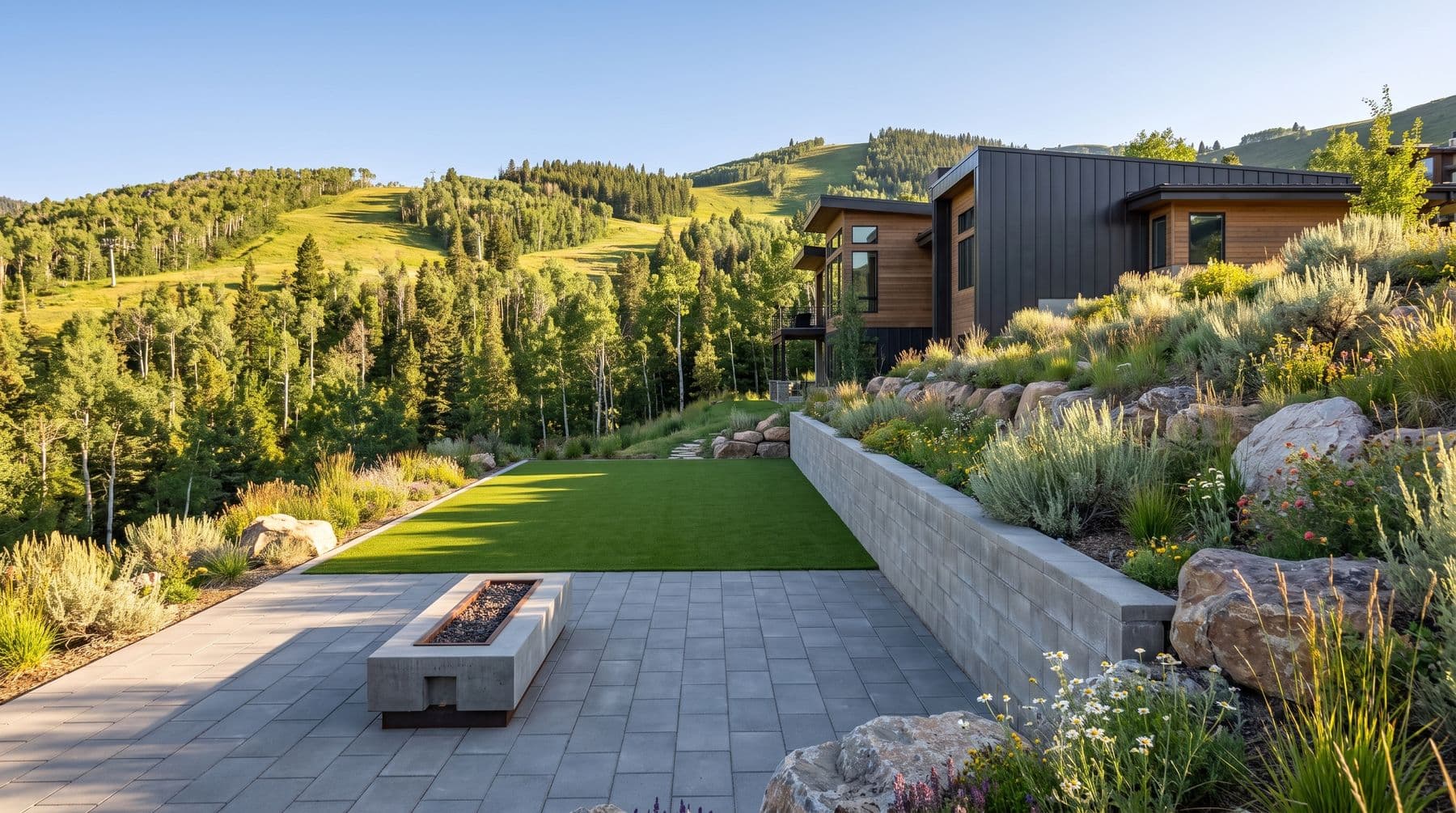
A level turf lawn and paver terrace terraced into a Park City hillside, with water-wise planting and ski runs behind

The short version

Installed artificial turf in Park City runs the same $13 to $19 per square foot we quote statewide, and mountain lots sit at the top of that band, so a typical 800–1,500 sq ft backyard lands around $13,000–$26,000. What is genuinely different here is everything around the turf. Park City's Land Management Code allows artificial turf only in limited quantities on decks, pathways, recreation and play areas, caps irrigated lawn at 20% of the landscaped area on anything over 250 sq ft, bills outdoor water at $10.00 to $37.84 per thousand gallons, and pays $3.00 a square foot to convert lawn to planting on the condition that artificial turf is not added to the property.

The rate is the same. The yard is not.

We quote one set of numbers for the whole service area: $13 to $19 a square foot for a standard landscape lawn, $14 to $22 for pet turf, $24 to $36 for a putting green, $26 to $40 for a paver patio, $4 to $9 for decorative rock and xeriscape. Park City does not get a separate price list. It gets the top of the existing one, and there are reasons rather than a mountain surcharge.

Access is the first. A Park City lot is usually sloped, often narrow at the side, and frequently ends at a drop rather than a fence. Where a machine cannot get to the work, the same job becomes wheelbarrow work and the labour line climbs. The second is base. Freeze-thaw up here cycles far more often than it does in Utah Valley, and every cycle works on anything holding water, so the base build we would scope in Orem is not automatically the base build for a lot above 6,500 feet.

Third is the calendar. The window between ground thaw and first snow is short, crews are competing for it, and a project that misses it waits for spring rather than starting in November. Fourth is snow storage, which is a design question before it is a cost: plowed snow has to be piled somewhere, and wherever it is piled sits under load for months and soaks every thaw. A paver terrace used as the snow dump needs the base to match, and it is far cheaper to decide that on paper.

The floor is the same as everywhere else. We do not take jobs under about $5,000, because mobilisation, demo setup and haul-off are largely fixed and swallow a small budget before any turf goes down.

What the code actually says about artificial turf

This is the part nobody in the trade will tell you, so read it here. Park City's Land Management Code, in the landscaping section amended by Ordinance 2023-53, says artificial turf is “allowed to be used in limited quantities on decks, pathways, recreation and play areas” and that its installation “shall not pool water and be installed to allow for drainage”. Under encouraged practices the same chapter says, flatly, that “artificial turf is not recommended in any landscaping due to its impact on the Urban Heat Island Effect”.

That is not a ban, and it is not a green light either. The honest read is that Park City will accept turf as a surface for the ground people actually use, and is not set up to approve a wall-to-wall green backyard. Which, for what it is worth, is how we would design a mountain lot anyway.

The review that enforces it comes with a landscape plan, and the code requires one in three cases: new development on an unimproved lot, work that modifies the building footprint, and projects proposing to modify more than 50% of the landscaped area. A whole-backyard conversion is squarely in the third case. Two other standards then bind:

  • At least 50% of the landscaped area must be water wise landscaping - drought-tolerant planting, hydrozoning, xeriscape, or an approved site-specific equivalent.
  • Irrigated lawn is limited to 20% of the disturbed area not covered by buildings, structures, impervious surfaces or active recreation areas, wherever the landscaped area is greater than 250 square feet.
  • Lawn is prohibited on slopes steeper than 3:1 and on strips less than eight feet wide.
  • Watering with city water is every other day from 1 May to 30 September, even addresses on even days, and only between 7:00 p.m. and 10:00 a.m.
  • Homeowner associations may not prohibit an owner from installing water wise landscaping - note that the protection is written around water wise planting, not around artificial turf, so design review still has a say.

The water bill is where Park City really differs

Our savings calculator models a Utah County lawn at 28 inches of supplemental irrigation a season - about 17.4 gallons a square foot, so roughly 26,000 gallons a year for 1,500 square feet - billed at an effective marginal $2.75 per thousand gallons. Both halves of that are wrong for Park City, in opposite directions. A mountain lawn's season is shorter, so it drinks somewhat less. The water costs several times more.

Park City Municipal's fee schedule bills single-family residential on a $75 monthly base whatever your lot size, with the first 2,000 gallons inside it. The next band, 2,001 to 5,000 gallons, is $7.00 per thousand and is described in the schedule as the indoor block. Everything above that is an outdoor block: $10.00 per thousand for “outdoor optimized”, $20.00 for “outdoor mild conservation”, and $37.84 for “outdoor without conservation”. On top of that sits a location-based energy surcharge of $0.71 to $5.04 per thousand gallons, because water up here has to be pumped.

Take 26,000 gallons as an upper bound for a 1,500 square foot lawn. In the $10.00 block, with the surcharge, that is roughly $280 to $395 a season. The same lawn on our Utah County model is about $72. Nothing about that makes turf pay for itself on water alone - it does not - but it is a real line rather than the rounding error it is down in the valley.

The blocks reset monthly, which is what catches people in July. On a lot of a quarter acre or less the $20.00 block starts at 20,001 gallons in a month, and a household using 5,000 gallons indoors reaches it with about 15,000 gallons of irrigation - on the order of 4,000 square feet of grass at the season average, and less than that in the month grass actually wants water. The ceilings move with lot size: 30,000 gallons on a quarter to three-quarter acre, 40,000 up to 1.24 acres, 50,000 above that.

The $3.00 a square foot you give up

Park City runs its own landscape incentive program, and it is unusually generous: $3.00 per square foot of converted lawn, up to $15,000 for a single-family customer. That is a dollar a foot more than the state's Division of Water Resources program pays, and it is the city's own money: Park City planning staff approve the plan and inspect the work.

The requirements are specific. The area has to be living, well-maintained lawn at the pre-conversion site visit - kill it first and you are out. It has to be more than 250 square feet. At least half the converted area must be replanted exclusively with plants the municipal code lists as fire wise, rock cover is held to 20% of the new ground cover, any irrigation must be drip with a WaterSense controller, and no water feature may be added. And then the line that decides the whole question: “Artificial turf cannot be added to the property.”

So the Park City arithmetic on 1,500 square feet of tired lawn is not turf against grass. It is $4,500 of the city's money for a planted conversion, against roughly $19,500 at the bottom of our range to turf the same area and keep a surface the family can use. Those are different products bought for different reasons, and the rebate is a genuine reason to plant the parts of the yard nobody walks on.

One caution on wording. The program says artificial turf cannot be added to the property, not to the converted area. Read strictly, that rules out taking the rebate on the front and turfing the back. Before you plan a yard that does both, ask program staff how they apply it and get the answer in writing - the application also requires that the project not violate any ordinance, so it is worth being sure on both sides.

Walls, patios and the permits behind them

Terracing is what makes a sloped Park City lot usable, and it is usually the largest line on the quote. We price retaining walls at $55 to $110 per face square foot, with engineering and permits additional - and in Park City the threshold is written down. A building permit, including drawings stamped by a registered engineer, is required for any retaining wall greater than four feet in total height.

Read the next sentence in that section before you design around it. A combination retaining wall - any series of walls separated horizontally by less than 1.5 times their height - is measured as one wall for that threshold. Two tidy three-foot terraces set close together are a six-foot wall as far as the permit is concerned. There are also height limits by location: six feet in a required rear or side setback, four feet in a front or street-side setback, with more only by administrative conditional use permit.

The flatwork rule catches people too. Park City requires a building permit for all non-bearing concrete flatwork, asphalt, and any impervious surface, regardless of size or area, including repairs and expansions. How a specific paver detail is classified is a question for the building department rather than for us, and it is worth asking early - the answer changes your schedule, not usually your budget.

How we would spend the budget on a mountain lot

Zone it. Turf the ground that gets used - the play area, the dog run, the strip beside the patio, the putting green if that is what the yard is for. Hardscape where the furniture and the fire feature go. Treat the rest as what it is, which on most Park City lots is a slope with a view, best served by native planting, boulders and drip - and at $4 to $9 a square foot for decorative rock and xeriscape, it is the cheapest square footage on the quote as well as the one the code prefers.

That is the same advice we would give in Draper, but here the code, the water blocks and the rebate all point the same way, which makes it an easier argument. It also produces a better yard: wall-to-wall anything on a mountain lot reads as suburban, and it is the most expensive way to get there.

Two honest caveats. Turf gets hot in direct summer sun - hotter than grass, which is precisely the heat island effect the code names - so plan shade over a dog run or a children's area rather than discovering it in July. And design review in Promontory, Glenwild and most of the gated communities has real teeth. We will assemble the scope, materials and dimensions for your submittal, but start it well before you want the crew on site, because approval is rarely quick and the build window is short.

Common questions

Is artificial turf allowed in Park City?

Yes, with limits. The Land Management Code allows artificial turf in limited quantities on decks, pathways, recreation and play areas, and requires that it drain rather than pool water. The same chapter says it is not recommended in landscaping generally, because of the heat island effect. In practice that means turf as a used surface is workable and a wall-to-wall green backyard is not the plan the city is set up to approve.

How much does artificial turf cost in Park City?

The same $13 to $19 a square foot installed we quote across northern Utah, with mountain lots landing at the top of the band - so roughly $13,000 to $26,000 for a typical 800 to 1,500 square foot backyard. Access, base depth for a harder freeze-thaw cycle, snow storage and the short build season are what push it up, not the postcode.

Can I get Park City's lawn rebate if I install artificial turf?

No. The program pays $3.00 a square foot up to $15,000 for a single-family customer, and its requirements state that artificial turf cannot be added to the property. If the area is scenery, the rebate is real money and planting is the better answer. If it is ground your family uses, turf is what you are buying and the rebate is not part of the comparison.

What does it cost to water a lawn in Park City?

Outdoor water is billed at $10.00, $20.00 or $37.84 per thousand gallons depending on how far up the monthly blocks you go, plus an energy surcharge of $0.71 to $5.04 per thousand. A 1,500 square foot lawn at 26,000 gallons a season runs roughly $280 to $395 in the lowest outdoor block - against about $72 for the same lawn on the Utah County rate our calculator models.

Next step© 2026

Get a free yard estimate*

Send your address and a couple of photos. We come measure, and you get a written number with base depth and materials spelled out.

Get my free estimate