Skip to content

Trees and shade

Turf under trees: the one place it genuinely beats grass

Most of this site is us talking homeowners out of things. Deep shade is the condition where the argument runs the other way — and the tree, not the lawn, decides how the job gets built.

Published August 22, 2026
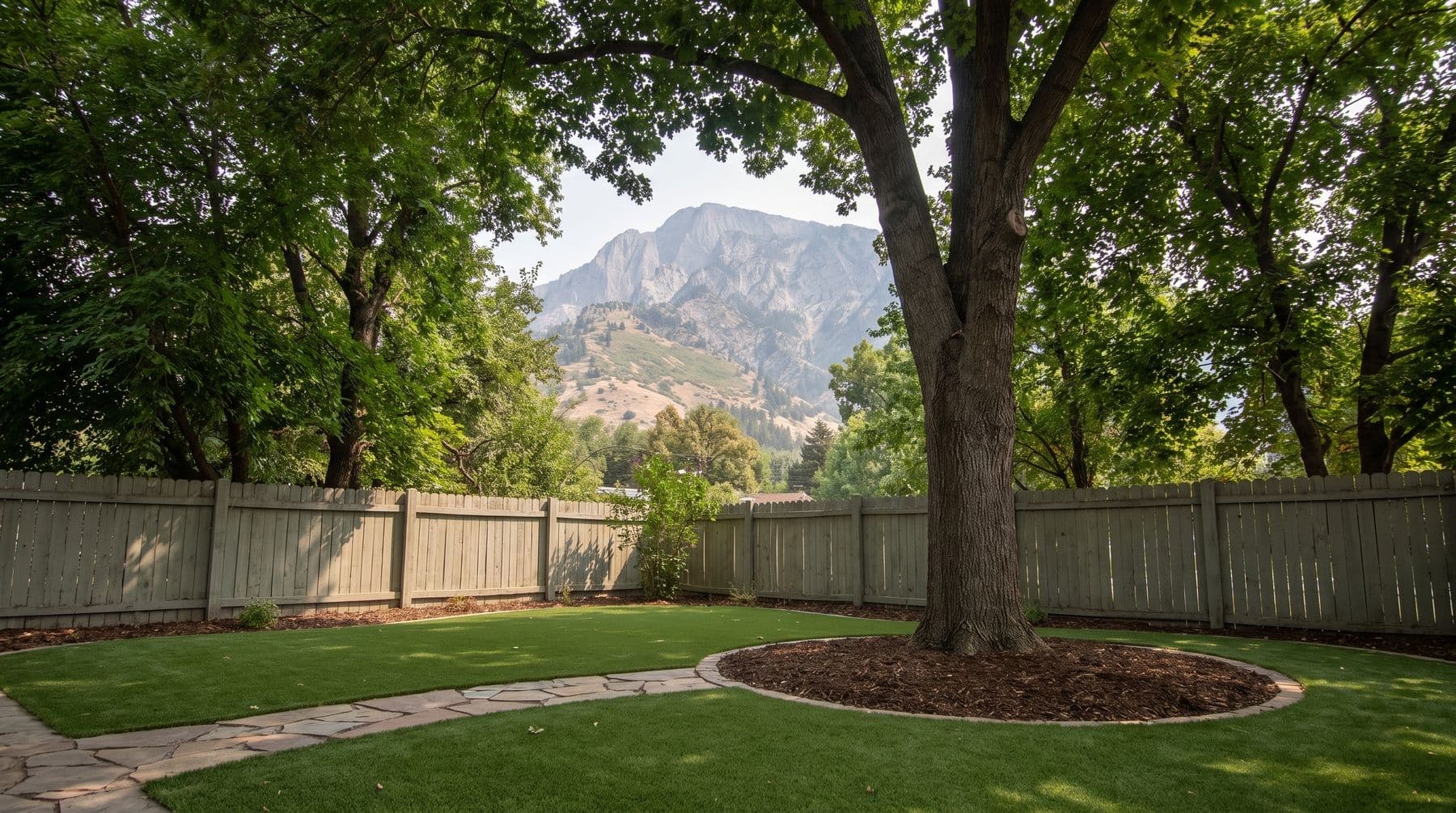
A backyard in deep dappled shade under a mature canopy, turf lawn running to a wide open mulch ring around the trunk, Mount Olympus beyond the fence

The short version

Cool-season grass performs best with a minimum of four to six hours of full sun a day, and Purdue's turfgrass specialists describe a dense, healthy lawn in shade as a challenge if not an impossibility. Artificial turf holds the same colour and density at any light level, which makes deep shade the one condition where it genuinely outperforms what it replaces. The constraint is the tree. The International Society of Arboriculture puts the critical root zone at a one-foot radius for every inch of trunk diameter, with 85% of the root mass and most of the roots inside the top 18 inches of soil, and says never to compact within it — so the standard three-to-four-inch excavated and compacted base cannot be built there. In Holladay, any tree two inches caliper or larger within twelve feet of a street, within twenty-five feet of a waterway, in a city park, or designated a Heritage Tree is protected, and the city's own permit form warns that landscaping projects involving grade alterations or tree removals, at any level, may require review before work starts.
Four to six hours of sun, and your yard has two

Purdue's turfgrass extension bulletin on shaded lawns opens with the number nobody selling seed leads with: turf performs best in full sun, with a minimum of four to six hours of full sun per day. Illinois Extension puts the floor lower — even the most shade-tolerant grasses want at least two hours of direct sunlight every day — and that is the floor, not a target. An established Holladay backyard under sixty-year-old maples, or a Pleasant Grove lot under the canopy that gave the town its name, is frequently under both figures for most of the season.

What goes wrong is more than thin grass. Trees compete with turf for light, water and nutrients at the same time. Air flow under a canopy is restricted, which raises humidity and disease pressure. The grass plants respond by going succulent — elongated leaves, restricted roots — so the stand gets thinner and less able to take traffic exactly where children and dogs are most likely to be, because shade is where everyone stands in July. Purdue's summary of all of it is blunt: maintaining a dense, healthy turf in shade is a challenge, if not an impossibility.

Then the weeds arrive. Shade-loving broadleaf weeds like wild violet and ground ivy have a tremendous advantage over grass in low light and usually dominate, and thin turf is rarely vigorous enough to prevent them re-establishing once they are controlled. Purdue calls that, in so many words, probably the best reason not to grow turfgrass in shade at all.

Species selection helps at the margin and does not solve it. USU Extension recommends fine-leaf fescue only under established trees or in areas that get no direct sun, and notes tall fescue tolerates more shade than Kentucky bluegrass. Almost every existing Utah lawn is bluegrass, which USU places in full sun to partial shade. So the honest fix is to tear out what is there and reseed the shaded ground in a species that will still be sparse, then overseed it again every autumn. That is a treadmill, and a lot of people have been on it for years before they call us.

Which brings us to the one claim this company makes without hedging. Artificial turf holds the same colour and the same density at four hours of sun, at two, and at none. Everywhere else on this site we describe turf as a trade — money now against maintenance later, a surface that gets hot, a product that is not grass and should not pretend to be. Under a mature canopy there is no trade. It is simply the better surface.

What the shade patch costs you to keep

Our savings calculator models a serviced Utah lawn at 26 mows a season on a $25 minimum call-out plus $22 per 1,000 square feet, five fertiliser and weed-control rounds on a $55 minimum, aeration at $85, and 28 inches of supplemental irrigation. The detail that matters for a shade patch is that those minimums do not shrink with the area.

Run 600 square feet of shaded lawn through it and the answer is just under $1,040 a year. A full 1,500 square foot lawn is about $1,290. Forty per cent of the area, eighty per cent of the cost — and the 600 feet is the part that never looked right in the first place.

Replacing it runs $13 to $19 a square foot installed, so 600 square feet lands at roughly $8,000 to $11,500. We do not take jobs under about $5,000, because mobilisation, demo and haul-off are largely fixed and swallow a small budget. A shade patch is usually just over that line, which is worth knowing before you decide to do the whole yard to justify the crew.

Water is where the two cities separate. A Pleasant Grove shade lawn drinks pressurized irrigation on a schedule the city sets: the secondary system is filled around mid-April, residents are asked to wait until 1 May to start watering, shutoff is anticipated around 9 October, odd-numbered houses water Monday, Wednesday and Friday, even-numbered houses Tuesday, Thursday and Sunday, nothing between 10 a.m. and 6 p.m., and nothing at all on Saturday. It is flat rate, so watering more costs nothing at the margin today and the honest water saving from removing that lawn is close to zero — until state law puts a meter on every secondary connection by 1 January 2030.

In Holladay the same lawn is on metered culinary water and the bill is real. Holliday Water Company's schedule effective 1 April 2026 runs $1.99 per thousand gallons for the first 30,000, then $2.51, $3.15 and $3.76, on a base charge of $30 a month for a three-quarter-inch meter. Salt Lake City Public Utilities, which serves the rest of Holladay, has moved residential customers to tiered pricing year round and charges its Salt Lake County customers 35% more than customers inside city limits. Our calculator uses $2.75 per thousand gallons as the marginal cost of irrigation; against the Holliday Water blocks that is a fair middle — high for a small lawn that never leaves the first block, low for a large one pushing into the third.

None of which is the reason to do this. Water is the smallest line on the page for a patch this size. The reason people call is that they have spent six years and several hundred dollars a year on ground that has never once looked like a lawn.

The tree is the client now

Once the decision is made, the design stops being about the lawn. The International Society of Arboriculture's Rocky Mountain chapter defines a tree's critical root zone as a one-foot radius from the trunk for every inch of trunk diameter measured at 4.5 feet above grade, and says to use the dripline instead wherever that gives a larger circle. A two-foot-thick trunk therefore carries a twenty-four-foot radius. On a typical Holladay or Pleasant Grove backyard, that is the backyard.

Two more figures decide how the job is built. Eighty-five per cent of the mass of a tree's root system sits inside that circle, and most of a tree's roots are within the top 18 inches of soil — the same 18 inches a turf crew wants to work in. These are not deep structural roots you can tunnel under. They are the ones doing the drinking, and they are directly under the grass you are removing.

The chapter's guidance on grade is specific, and it is the part that collides with a standard turf build. Never compact the soil within the critical root zone. Never place fill or organic material directly against the trunk. Avoid adding more than two to four inches of fill, and remove no more than six inches from existing grade. Impervious surfaces over a root zone are to be avoided outright.

Now read our own base spec next to that. A standard install is three to four inches excavated, fabric over clay, then crushed and refined granite compacted in lifts. The excavation depth is survivable at the outer edge of the circle. The compaction is not survivable anywhere inside it, and compaction is precisely the step that makes a turf lawn stay flat. That is the real tension in this job, and any installer who does not raise it either has not thought about it or is hoping you will not notice for three summers.

There is a second half nobody mentions at the quote stage. That tree has been drinking your lawn's irrigation for decades. Pull the lawn out and the sprinklers leave with it. A mature tree that has never needed its own water suddenly does, in the same summer it has just had a crew working over its roots.

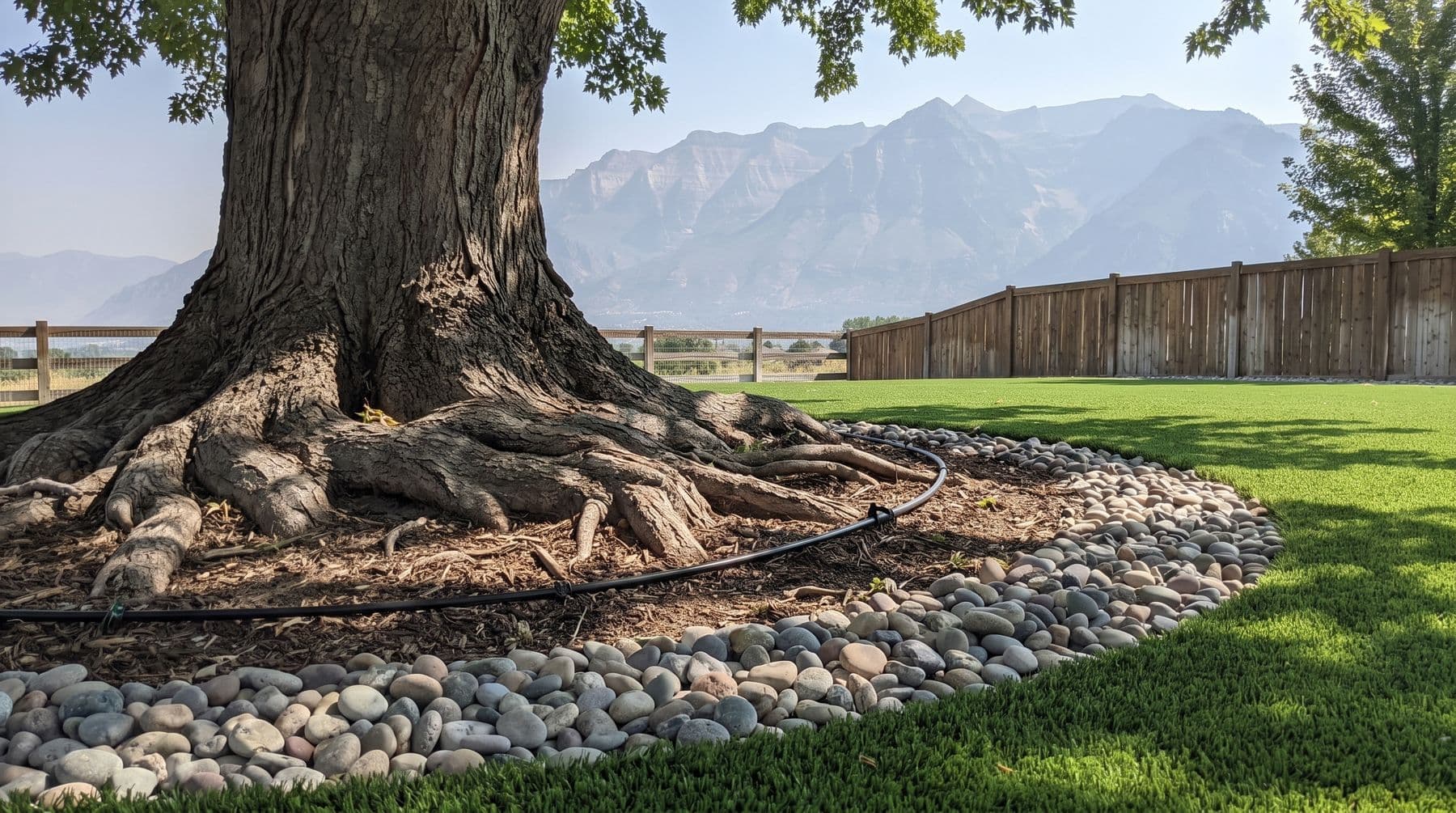
The flared surface roots of a mature tree left open in cobble and mulch, with a drip line run into the root zone and the turf edge held back beyond it

How we build inside a root zone

None of the above makes the job impossible. It makes it a different job, and one that has to be drawn before it is priced. What changes:

  • Leave the ring open. The simplest answer is not to turf the inner root zone at all — cobble or bark over the roots, held back off the trunk, with the turf edge started outside it. Decorative rock runs $4 to $9 a square foot against $13 to $19 for turf, so on this one occasion the correct answer is also the cheap one.
  • No machine compaction inside the circle. Base goes in by hand in thinner lifts, and where a plate compactor would normally run we accept a base that is less dense and a surface that is fractionally less perfect. That is a deliberate trade, and it belongs in the conversation rather than in a footnote.
  • Build up rather than cut down. Where turf has to cross roots, we lay over existing grade on a shallow permeable base instead of excavating to depth. It reads as a gentle rise across the root plate. It is a design decision, not a defect, and it is worth being told about in advance.
  • Cut nothing structural. Anything much over two inches in diameter gets designed around, not sawn. Moving an edge three feet costs a fraction of what replacing a sixty-year-old tree costs, and there is no version of that trade that favours the turf.
  • Put the tree back on water. USU Extension's guidance for Utah landscape trees is slow, deep irrigation reaching at least 10 to 20 inches of soil, at least once a week through the dry months, with drip emitters around 2 to 3 gallons per hour in clay and 5 to 8 in sand — short, frequent cycles wet the top few inches and nothing below. A drip loop out in the root zone is a small line on the quote and the difference between a tree that shrugs off the work and one that declines over three summers.
  • Size the ring to the tree, not to the layout. Turf over a root zone is a permeable surface, but it is not a neutral one. Every square foot left open is drainage and gas exchange the tree keeps, so the ring gets drawn from the trunk diameter outward and the lawn shape follows it.

Holladay writes it down. Pleasant Grove does not.

Holladay is one of the few cities in our service area with a tree ordinance that reaches beyond the park strip, and the city's own Grading / Tree Removal Permit application is the clearest statement of it. Grade alterations sit under Ordinance 13.76.700, tree removals under 13.77.080 and .090, and the stated purpose is to protect critical tree canopy resources in Holladay as a matter of community identity, air and water quality, and property values.

What that means for a backyard project:

  • Protected trees, under 13.04.040, are any tree two inches caliper or larger in a city park, within twelve feet of a street, within twenty-five feet of a waterway, or designated a Heritage Tree. The tree in your park strip is comfortably inside twelve feet of a street.
  • The rules reach reduction of tree canopy caused by demolition, construction or reconstruction, grade alterations and impervious surface emplacement — not only outright removal. A patio that takes a third of a canopy is inside the ordinance.
  • They do not apply to high-risk trees on private property more than twenty-five feet from a waterway.
  • A tree removal permit requires a statement of impact supported by aerial imagery, or a Tree Canopy Sustainability Plan under 13.77.080D, plus a proposed canopy replacement plan which may be split fifty per cent on site and fifty per cent off site. The permit fee is $57.57.
  • A grade alteration submittal wants existing and proposed grading, every proposed retaining wall, and any irrigation or waterway crossing, abutting, or within fifty feet of the property.
  • And the line printed in red on the city's own form: landscaping projects, associated or unassociated with a building permit, which include grade alterations and/or tree removals, at any level, may require review and approval prior to commencing.

What we would actually do with the yard

We have not found an equivalent private-tree removal permit in Pleasant Grove's published code, and we are not going to tell you there is none — ask Community Development before a saw comes out, because that is a five-minute phone call against a fine. What is identical in both cities is the biology. A permit costs $57.57 in Holladay. A dead sixty-year-old maple costs a great deal more in either city, and no ordinance is the thing that saves it.

So we zone it. Turf the shaded ground the family actually uses, because that is the surface that finally works there. Leave the inner root zones open in cobble or bark, on their own drip, sized off the trunk. Then treat the sunny half of the yard as a separate question — if that grass is thriving and you enjoy looking after it, keep it, and if it is not, planting is cheaper than either alternative.

Purdue's own conclusion is that for most shaded areas it is more practical and more attractive to use something other than turfgrass. We agree with the sentence and would only add what the something else should be: artificial turf where the ground gets walked on, and open mulch where it does not.

One last note, and it is the rare case where the standard objection to turf goes the other way. Artificial turf gets hot in direct summer sun — we say so on every other page here. Under a full canopy it does not, because nothing under a full canopy does. The shadiest lawn in the yard is the one place where the heat argument against turf simply does not apply, and it is also the only place grass was never going to win.

Common questions

Will artificial turf look right under a big tree?

Yes, and it is the condition where it looks best relative to the alternative, because it holds the same colour and density at any light level while grass thins out below roughly four to six hours of sun. The one honest caveat is leaf litter: a shaded lawn collects it, and it has to be blown or raked off rather than left to break down into the infill, where it becomes a seed bed for weeds growing on top of the turf.

Will installing artificial turf kill my tree?

It can, and the mechanism is compaction and lost water rather than the turf itself. The International Society of Arboriculture puts 85% of a tree's root mass inside a critical root zone of one foot of radius per inch of trunk diameter, most of it in the top 18 inches of soil, and says never to compact within that circle. A standard turf base is excavated and compacted, so inside the root zone the build has to change: hand work in thin lifts, no plate compactor, building up rather than cutting down, an open ring of cobble or bark around the trunk, and a drip line to replace the irrigation the lawn used to supply.

Do I need a permit to remove a tree in Holladay?

If the tree is protected, yes. Holladay's ordinance covers any tree two inches caliper or larger in a city park, within twelve feet of a street, within twenty-five feet of a waterway, or designated a Heritage Tree, and it also covers canopy reduction caused by construction, grade alteration or impervious surfaces. The application needs a statement of impact with aerial imagery or a Tree Canopy Sustainability Plan, plus a canopy replacement plan, and the fee is $57.57. The city's form also warns that landscaping projects involving grade alterations or tree removals, at any level, may require review before work starts, so call Community Development before the crew is booked rather than after.

How much does it cost to turf a shady patch of lawn?

The same $13 to $19 a square foot installed we quote everywhere, so about $8,000 to $11,500 for 600 square feet. Root-zone work prices toward the top of that band, because hand excavation and hand compaction replace machine work. We do not take jobs under about $5,000, and a shade patch is usually just over that line.

Next step© 2026

Get a free yard estimate*

Send your address and a couple of photos. We come measure, and you get a written number with base depth and materials spelled out.

Get my free estimate